
Euless Root Zone Calculation for TPZ Fencing: Compliance Guide
Mid-Cities Fence Rentals specializes in precise Tree Protection Zone (TPZ) calculations for Euless construction projects. Our local expertise spans Morrisdale Estates and Downtown Euless, ensuring accurate root zone measurements that meet municipal compliance standards for residential and commercial developments.
Protecting Euless Trees During Construction
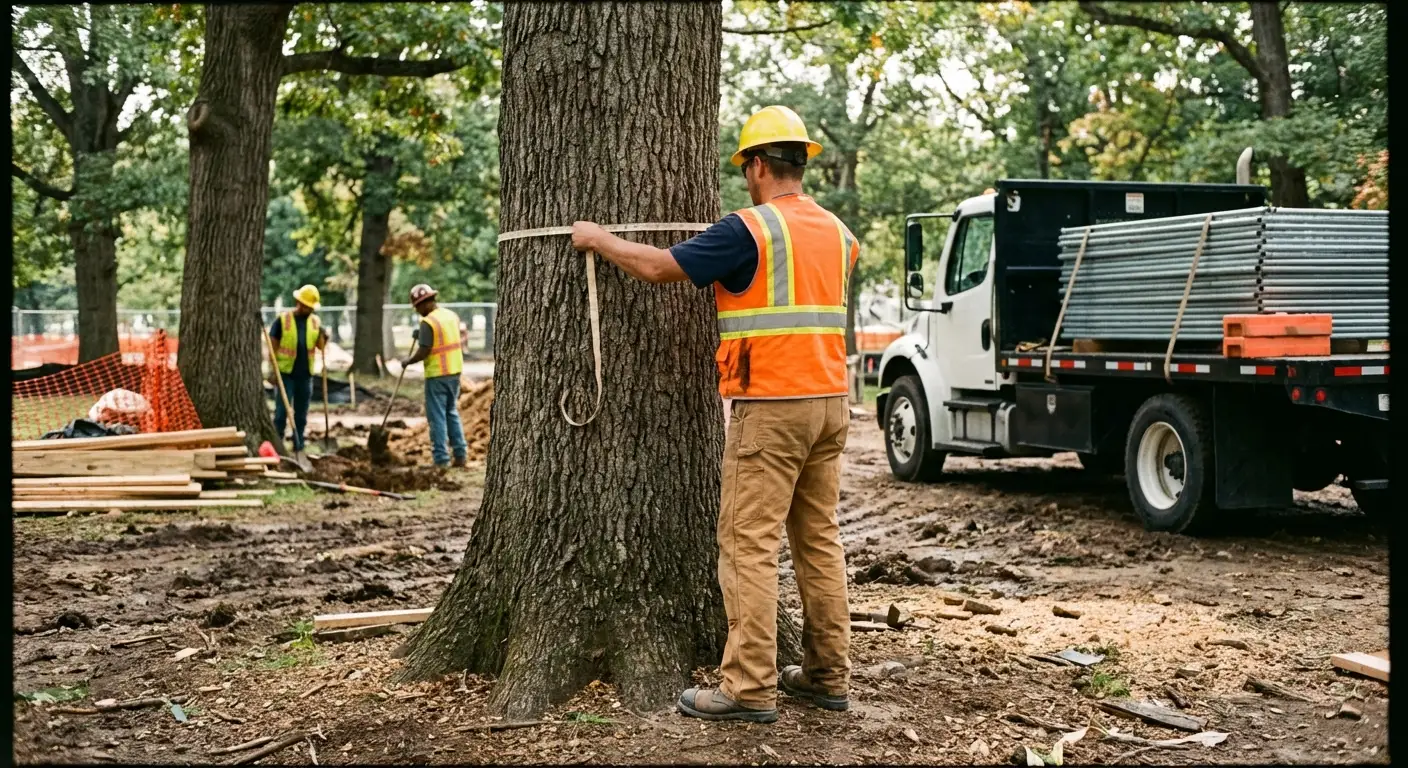
When we set up TPZ fencing in Morrisdale Estates, we start by identifying every tree over 6 inches DBH. Our crew uses the 1:1 rule—for each inch of trunk width, we allocate 1 foot of protected space. That means a 24-inch oak near Midway Park gets a 24-foot radius TPZ. We stake the perimeter with interlocking barriers from our modular fence system, keeping equipment and materials clear. The clay-heavy soil around J.A. Carr Park requires extra care—compaction here can suffocate roots faster than in sandy areas.
Calculation Steps
- Measure the trunk diameter at 4.5 feet above ground (DBH)
- Calculate the TPZ radius: 1 foot per inch of DBH
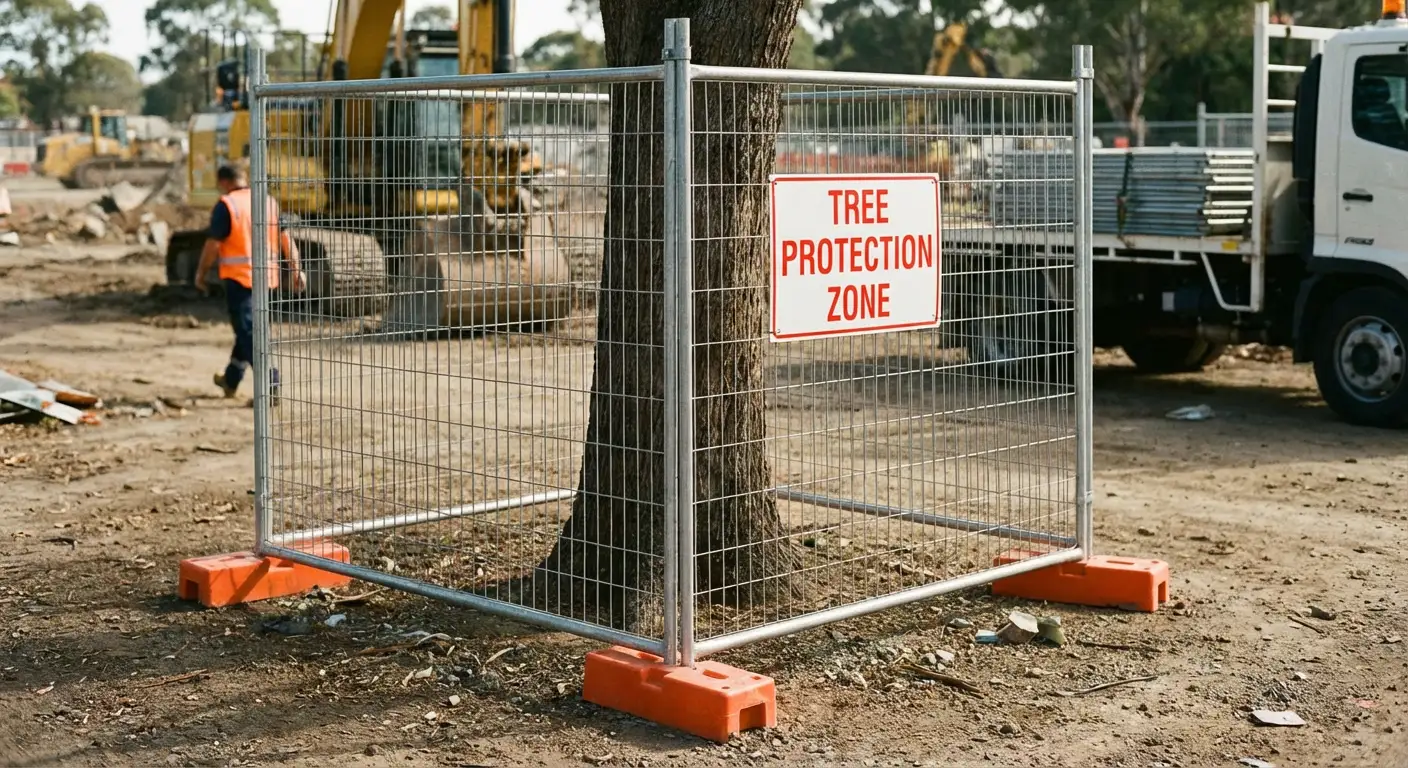
- Mark the protected zone with TPZ rental hardware
- Verify no excavation or storage within the TPZ boundary
- Inspect daily for root disturbance in Downtown Euless clay soils
Calculating Root Zones for TPZ Compliance in Euless
Field technicians in Downtown Euless / J.A. Carr Park Area calculate the Tree Protection Zone (TPZ) before installing tree protection zones. This calculation prevents heavy machinery from crushing roots in established residential zones like Midway Park. Workers use the trunk diameter at breast height to establish the radius. Failure to maintain these boundaries violates tree protection ordinances and risks long-term canopy loss for mature trees in Oakwood Terrace.
Key Terminology
- Critical Root Zone
- The area around a tree where root loss causes significant decline.
- TPZ Fencing
- Protective barriers installed to prevent soil compaction near trees.
- Soil Compaction
- Compression of soil particles reducing air and water infiltration capacity.
- Arborist Report
- Document identifying tree species and required protection radius per local code.
- Root Flare
- The transition point between the trunk and the root system.
- Permeable Surface
- Ground cover allowing water movement into the tree root structure.
In Simple Terms
Field crews determine the radius of tree protection zones by measuring the trunk diameter and applying local arboricultural standards to prevent root damage.
Root Zone Calculation for TPZ Fencing: Compliance Guide
Defines root zone requirements for TPZ fencing installation compliant with Euless regulations.
| Root Zone Depth | Minimum 18 inches below grade to ensure fence post stability |
|---|---|
| Post Spacing | Typically 6 to 8 feet apart depending on fence length and design |
| Soil Type Consideration | Adjust depth and diameter based on soil compaction and drainage |
| Diameter of Post Hole | At least 8 inches to accommodate TPZ fencing posts securely |
| Concrete Backfill Volume | Approximately 1.5 cubic feet per post to stabilize root zone |
| Compliance Standards | Meets OSHA and local Euless municipal codes for temporary fencing |
| Signage Interval | Every 30 linear feet |
Root Zone Calculation for TPZ Fencing: Precision Compliance
Accurate zone measurements protect infrastructure and ensure regulatory compliance in Euless construction sites.
Common Mistakes in Root Zone Calculation for TPZ Fencing Compliance
Root zone calculation for TPZ fencing requires precision to protect tree health and meet regulations. Avoiding typical errors prevents costly delays and damage in Euless neighborhoods like Oakwood Terrace and Stonewood.
Ignoring Tree Species Root Spread Variations
Overlooking specific root spread patterns leads to miscalculating the TPZ, risking root damage and noncompliance with local ordinances.
Consult species-specific root data and adjust TPZ radius accordingly for accurate fencing placement.
Using Uniform TPZ Radius Without Site Assessment
Applying a one-size-fits-all radius fails to account for soil type, tree age, or site conditions, causing inadequate protection zones.
Perform on-site evaluations to tailor TPZ measurements based on actual root zone conditions.
Neglecting Existing Underground Utilities and Irrigation
Failing to map utilities can result in conflicts and damage during fence installation, complicating compliance efforts.
Identify and mark all underground lines before calculating and installing TPZ fencing.
Incorrect Measurement from Tree Trunk Instead of Drip Line
Measuring from the trunk center underestimates root spread, risking encroachment on vital root zones.
Measure TPZ radius from the tree’s drip line edge to ensure full root protection.
Installing TPZ Fence Too Close to Construction Activity
Fencing placed too near heavy equipment causes root compression and soil compaction, harming tree health and violating protection standards.
Maintain adequate buffer zones between fencing and construction zones to minimize root disturbance.
Root Zone Calculation for TPZ Fencing: Compliance Guide — Part 2
We get it up fast, so you can get back to business—but never at the cost of compliance or tree health. Since Amir Khan founded Mid-Cities Fence Rentals in 2008 after seeing storm-damaged sites in Euless, we’ve treated every temporary perimeter as both a safety barrier and an ecological boundary. Our crew trains on local canopy rules, not just OSHA standards, because protecting roots protects your project timeline.
-
Measure Twice, Install Once
We verify root zone boundaries using certified survey markers and municipal tree ordinances before any panel goes in. Guesswork leads to rework—and in Euless, that often means violating Heritage Park-adjacent tree buffers or Midway Park setbacks.In PracticeOn a Morrisdale Estates site near West Euless Blvd, we adjusted panel layout after confirming protected live oaks extended root zones beyond visible drip lines.
-
Adapt Bases to Soil, Not Vice Versa
Euless’s clay-heavy soils shift with moisture, especially around older 1950–1980 builds. We pair concrete-steel bases with real-time compaction checks to prevent tilting within TPZ perimeters.In PracticeNear J.A. Carr Park, saturated ground required steel-reinforced bases to maintain fence plumb through spring rains without disturbing root systems.
-
Comply Locally, Not Generically
Statewide TPZ rules don’t account for Euless’s specific canopy protections. We cross-reference city arborist maps with our tree protection ordinances guide to align every installation with municipal expectations.In PracticeA Downtown Euless job avoided fines by rerouting a temporary gate after confirming a heritage pecan’s protected radius overlapped the original access plan.
-
Stability Without Penetration
Driving posts near tree roots risks long-term damage and code violations. Our post-driven fence alternatives use surface-mounted systems that meet wind-load resistance standards without underground intrusion.In PracticeIn Midway Park, we deployed interlocking panels with zero-trip bases to secure a worksite while preserving shallow root networks under mature elms.
Every TPZ fence we install in Euless neighborhoods—from Morrisdale Estates to Midway Park—meets municipal tree protection requirements without sacrificing rapid deployment or structural integrity.
Root Zone Calculation for TPZ Fencing in Euless
TPZ fence layout in Euless follows trunk size, site constraints, and local tree protection around Stonewood, Morrisdale Estates, and J.A. Carr Park.
How is root zone calculated for TPZ fencing in Euless?
Root zone work in Euless starts with the tree trunk diameter, measured at breast height, then the TPZ radius is set from that size. Around Stonewood lots with 1950_1980-era yards, fence lines often sit close to mature oaks, so field crews keep the barrier outside the measured root zone and note paved edges, curbs, and utility strips before staking.
What field signs change the TPZ layout near Morrisdale Estates?
Morrisdale Estates sites south of West Euless Boulevard often show compacted clay, old driveway cuts, and buried irrigation. Those conditions tighten the usable install area, so the TPZ line gets adjusted around exposed roots, mulch rings, and grade breaks near the fence path. Euless crews mark those changes before panel placement.
How do crews avoid root damage near Trinity High School?
At Trinity High School, fence work often happens beside athletic landscaping, sidewalks, and parking edges. The TPZ barrier is laid out to keep equipment out of the root area, and post holes are checked against visible roots before digging. In Euless, that means hand work near the trunk and no trenching through the protected zone.
What happens when the TPZ overlaps a driveway or sidewalk in Downtown Euless?
In Downtown Euless and the J.A. Carr Park area, old concrete walks and narrow setbacks often cross the TPZ. Field crews document the overlap, shift the fence alignment where possible, and keep the protected zone intact on the tree side of the line. If the layout cannot move, the root zone stays protected with barrier fencing.
How does Euless clay soil affect TPZ fencing placement?
Euless clay holds moisture and seals over disturbed ground fast, so a misplaced post hole can stress roots near Stonewood and Morrisdale Estates. TPZ fencing sits outside the root zone, with wider protection where canopy spread and trunk size indicate larger underground extent. Crews avoid stockpiling panels or spoils inside that perimeter.
What records are kept for TPZ compliance on a fence job?
Mid-Cities Fence Rentals field notes in Euless usually include tree location, trunk size, fence alignment, and any root exposure seen during layout. That record helps show the TPZ line was set around the protected area, not through it. OSHA site safety practices and local tree protection notes from the Euless job area guide the setup.
Request TPZ Fencing Compliance Calculations for Euless Projects
Obtain accurate root zone measurements for tree protection zone fencing to meet local regulatory requirements and project specifications.
Serving construction sites throughout the Euless Texas area